Are You Losing Money by Paying Only the Minimum Due on Your Credit Card? – DSA LOAN AGENT Service Offers You Sound Advice
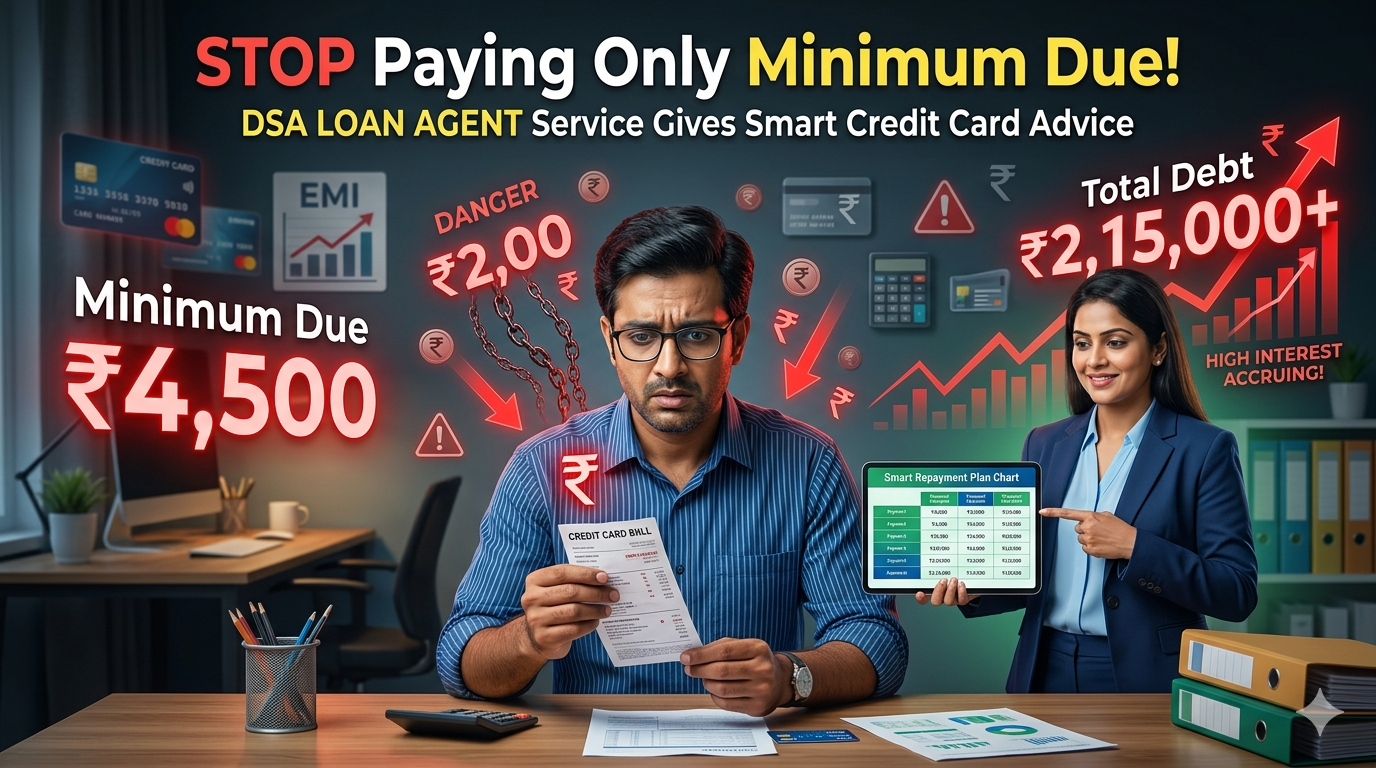
Many of you apply for credit cards to meet your various needs; while some receive a low credit limit, many others are granted limits running into the lakhs.
Ideally, one should utilize only 30% of their credit card limit at any given time; exceeding this threshold causes your credit utilization ratio to rise significantly. Even those who are aware of this often end up utilizing their entire credit limit and paying back only the “minimum due” amount.
What they fail to realize is that by paying only the minimum due on their credit card, they are actually incurring financial losses. If you know anyone who uses credit cards extensively, please share this blog with them immediately to help them out.
Hello! My name is Akhil, and I work as a freelance DSA Loan Agent. In this blog post, I aim to shed light on a common mistake that many of you make regarding credit cards.
Please do not skip any part of this blog; read it through to the end and let me know your thoughts in the comments section below.
To begin with, credit cards are offered by banks of all types; however, the interest rates charged vary from one bank to another. The most important point to remember is that you should never utilize more than 30% of your available credit limit.
Many of you—whether knowingly or unknowingly—make this mistake time and again.
In certain instances, people withdraw or spend more than 30% of their limit and subsequently pay back only the minimum due amount; doing so results in them losing a significant amount of money.
How Should You Pay Your Credit Card Bill—
Instead of Just Paying the Minimum Due? If we look at the situation in Andhra or Telangana, many people use credit cards extensively. Unable to repay the full amount they have spent, they often opt for the “minimum due payment” option to settle their bills.
After making this payment, many of them feel relieved, thinking they have successfully “pushed this month’s burden forward.” However, what they fail to realize is that they are making a grave error; by doing so, they end up losing a significant amount of money.
While paying the minimum due can be beneficial in certain specific situations, those who make this a monthly habit are incurring substantial financial losses. Paying the minimum due on credit cards may seem like an easy solution, but repeating this practice every month carries a high risk of losing a considerable sum of money.
Furthermore, we observe that banks themselves sometimes fail to provide adequate clarity on this matter. Misinformation often circulates suggesting that paying the minimum due on a credit card helps avoid EMI charges; consequently, many people are misled into believing this to be true. As a result, people end up paying unnecessary interest and losing money without any actual need to do so.
Recognizing that this common mistake is occurring
we—at DSA Loan Agent Service—have written this blog post to offer you sound advice. If you follow this guidance, you can effectively save your hard-earned money. We urge you to immediately share this blog post with anyone you know who uses credit cards frequently.
If you require any type of loan, simply click the button displayed here to apply for one.
First, let us understand exactly what a “minimum payment” entails.
For many people, the moment they see the “minimum payment” option on their credit card statement, they simply pay that amount without giving it much thought—reasoning, “Since it’s such a small amount, why not just pay it?” Simply put, a “minimum payment” on a credit card means repaying only a portion of the money you have utilized
specifically, paying just 5% of the outstanding balance is often considered sufficient.
Let me give you an example:
A crucial point you must understand is this:
Even after you have paid the “minimum due” amount on your credit card bill, interest continues to accrue on the *entire* outstanding balance. For those who make only the minimum payment every month, this practice results in significant financial loss.
How high is the interest rate on a credit card?
To be honest, the interest rates on credit cards are extremely high.
APR (Annual Percentage Rate): It can range anywhere from 36% to 48%.
Monthly Interest: Approximately 3% to 4%.
While this may appear to be a very small figure at first glance, it causes substantial financial detriment to individuals who consistently pay only the minimum due amount each month.
Let me illustrate this with an example:
Suppose you have an unpaid balance of ₹19,000 from a previous bill; when the new month’s bill arrives, this outstanding balance is added to it—and the total continues to snowball month after month.
Eventually, your total outstanding bill will spiral out of control.
What is an “EMI-Free Loan” or a “Credit Card Takeover”?
First, let’s understand the concept of a “Credit Card Takeover” (often referred to as CCT by many). This process involves clearing your outstanding credit card bill by securing a personal loan at a significantly lower interest rate.
Through our DSA Loan Agent Service, you can access the following benefits:
We offer an “EMI-Free Loan” option.
We facilitate personal loans at competitive, low interest rates.
We provide dedicated support to ensure that your loan is processed and disbursed quickly.
How does an “EMI-Free Loan” help you?
1. Savings through Lower Interest Rates
Credit cards typically carry an interest rate of 40% or higher; in contrast, opting for a personal loan allows you to benefit from a significantly lower interest rate.
2. Flexible Repayment Options
EMI-free loans offer a variety of flexible options:
The monthly EMI amount is substantially lower.
The loan principal is gradually cleared alongside the interest payments.
3. Protects Your CIBIL Score
Late payments can severely damage your CIBIL score.
With an EMI-free loan:
You can clear all outstanding credit card dues.
Your CIBIL score will see significant improvement.
4. Avoid Late Fees:
Credit card payments can sometimes be missed, resulting in penalties. However, if you opt for a loan takeover (transferring your existing debt), there is a good chance you can avoid such issues.
Example: How Paying Only the Minimum Due Increases Your Debt
Let us understand this with a simple real-life example.
| Credit Card Outstanding | Minimum Due (5%) | Monthly Interest | Remaining Balance |
|---|---|---|---|
| ₹50,000 | ₹2,500 | 3.5% | ₹47,500 + Interest |
Suppose your total credit card bill is ₹50,000. Instead of paying the full amount, you choose to pay only the minimum due of ₹2,500.
Many people think that after paying the minimum due, no extra charges will apply. However, this is not true.
The bank will continue charging interest on the remaining ₹47,500. Most banks charge around 3% to 4% monthly interest, which becomes nearly 36% to 48% annually.
If you continue paying only the minimum due every month, your outstanding amount keeps increasing because of:
- Monthly interest charges
- GST on interest
- Late fees (if payment is delayed)
- New transactions added to the bill
Over time, this can turn into a serious credit card debt trap, making it very difficult to clear the full outstanding amount.
How is a DSA Loan Agent Service Useful?
Let me explain how a DSA Loan Agent can be of assistance to you:
First, let’s understand what a DSA is. DSA stands for Direct Selling Agent.
A Direct Selling Agent can be either an individual or a company that acts as an intermediary for banks, financial institutions, telecom companies, or various service providers.
The primary function of a DSA Loan Agent is to promote and sell a wide range of products—such as personal loans, home loans, credit cards, and insurance policies—on behalf of these service providers. By doing so, they earn a certain amount of commission.
To put it simply in terms of fieldwork, their role involves directly approaching potential customers, explaining the product in detail, collecting the necessary documentation for the specific product, and providing significant assistance throughout the application processing stage.
If a product sale is successfully finalized for a customer, the agent receives a commission or incentives. Many large banks and corporations utilize such DSA agents to drive their growth and expand their business operations. Conclusion of this Blog Post:
I am not saying that paying only the minimum due on a credit card is never a viable option; for those who do so for just one or two months, it may be acceptable.
However, for those who make this a long-term habit, it becomes a significant financial burden—one that they often fail to recognize until it is too late.
If you know anyone who is making such mistakes, please share this blog post with them immediately to help them out.
If any of you require a Personal Loan, Home Loan, Mortgage Loan, Auto Loan, NRI Loan, Education Loan, Insurance, Credit Card, MSME Loan, or any other type of loan, please contact us immediately at the number displayed below.
Alternatively, you may fill out and submit your details in the form provided below, and one of our agents will get in touch with you.
If you have any further questions, please let us know in the comments section ; we will address them by creating a dedicated blog post or video for you.